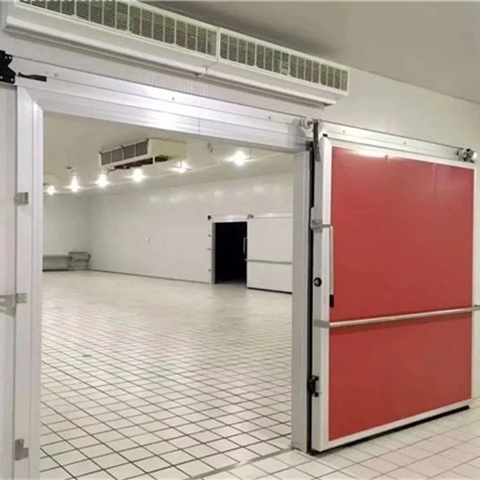
The expansion valve, unit load, fan, and defrosting jointly adjust evaporation temperature to meet storage needs, ensuring stable, gradual operation.
1. Thermostatic Expansion Valve Fine-Tuning (Core Method)
To adjust the evaporation temperature using a thermal expansion valve: turning the valve stem clockwise decreases the throttling opening, reducing refrigerant flow and lowering the evaporation temperature; turning it counterclockwise increases the flow and raises the evaporation temperature. Then, only make 1/4-turn adjustments at a time, and observe the pressure and storage temperature after 30 minutes. Therefore, avoid large, sudden changes to prevent liquid slugging into the compressor. For electronic expansion valves, you can directly adjust the evaporation temperature by setting the target value on the control panel, and the system will automatically regulate the opening for higher precision.
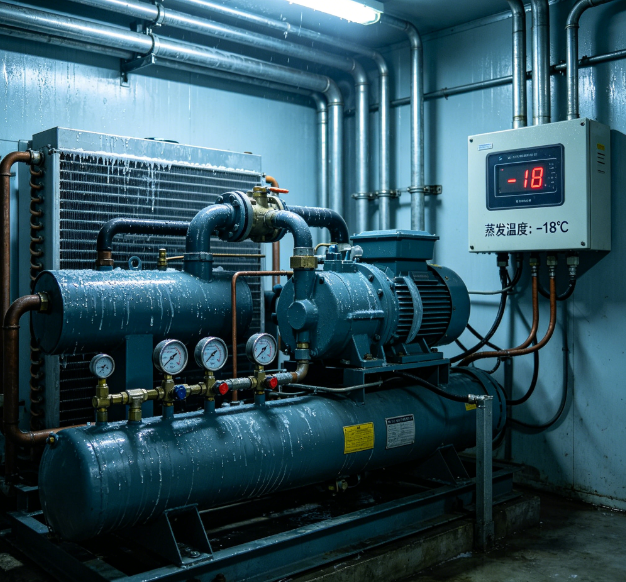
2. Adjusting the fan airflow and speed
To adjust the evaporation temperature, you can change the evaporator fan speed: increasing the speed accelerates heat exchange and slightly lowers the evaporation temperature under the same load, while decreasing the speed slows heat exchange and raises it. Low-temperature quick-freezing warehouses typically run fans at full speed, whereas fresh-keeping warehouses use variable frequency speed control for temperature regulation.
3. Unit operating load matching
Multi-compressor units can start and stop a number of compressors. When load or temperature is high, start more compressors to lower the evaporation temperature. Conversely, under low load, fewer compressors can be started, causing the evaporation temperature to rise. Variable frequency compressors directly adjust their operating frequency; higher frequencies increase cooling capacity and lower evaporation temperature.
4. Defrosting Assists in Stabilizing Temperature
To properly adjust evaporation temperature, first consider the impact of frost: buildup on the evaporator hinders heat exchange, causing the temperature to drop abnormally low. Therefore, regular electric or hot gas defrosting removes the frost, restores heat exchange, and brings the reading back to the standard range. As a reference, the evaporation temperature in a fresh-keeping storage room is generally 5–8°C lower than the storage temperature, and in a low-temperature freezer, it is 10–15°C lower. Finally, after you complete the adjustment, always check the high and low pressures to ensure safe compressor operation.
Welcome to inquiry about products related to walk in freezer, condenser, and panels.
You also can check our Tiktok, Youtube, Instagram channel for more video show.