1. Distinguish Refrigeration Compressors by Type
Both screw-type and reciprocating (piston-type) refrigeration compressors belong to the category of positive-displacement compressors. However, the screw-type refrigeration compressor represents a modern, high-speed variant. In this article, we'll help you distinguish refrigeration compressors by highlighting the main differences between these types. In fact, understanding how to distinguish refrigeration compressors based on their type can greatly assist in making the right equipment selection.
2. Distinction by Operating Principle
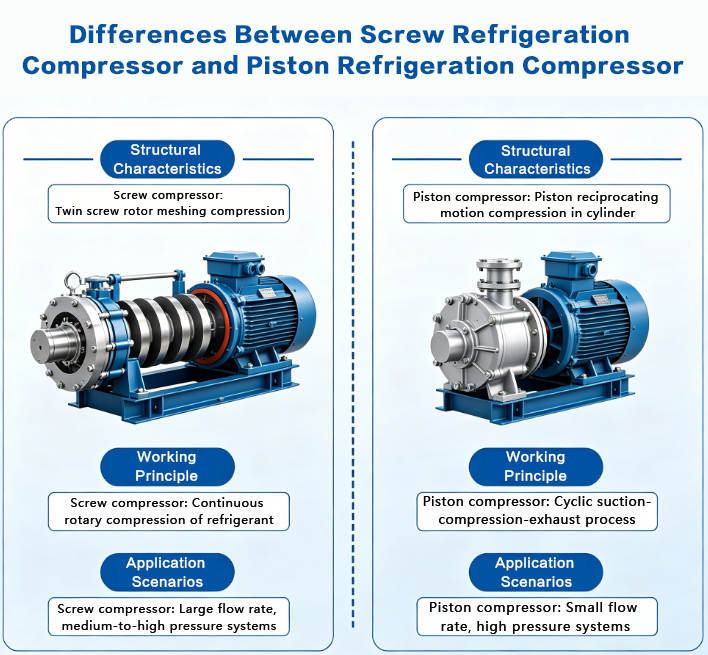
In terms of the fundamental principle of gas compression, both types achieve gas compression through a change in working volume. The key difference lies in the specific mechanism by which this change in working volume is realized. The reciprocating compressor alters its cylinder's working volume through the motion of a crankshaft-connecting rod mechanism. In contrast, the screw compressor achieves this change through the rotational motion of rotors directly coupled to the shaft. With this knowledge, it is easier to distinguish refrigeration compressors by their unique mechanisms and applications.
3. Distinction by Overall Structure
Unlike the reciprocating compressor, the screw compressor dispenses with components such as cylinders, pistons, piston rings, and cylinder liners—parts that are typically prone to wear. Consequently, the machine features a compact structure, small footprint, and light weight.
Furthermore, it possesses no clearance volume, thereby eliminating the risk of "liquid hammer" (hydraulic shock) should a small amount of liquid inadvertently enter the machine. It is capable of achieving stepless capacity control ranging from 10% to 100% through the use of slide valves.
This feature offers a wide scope of application as well as stable and reliable operation. The machine requires infrequent maintenance, boasting a potential fault-free operating duration of (2–5) × 10⁴ hours.
Moreover, the utilization of lubricating oil enhances both the machine's cooling efficiency and sealing performance, resulting in lower discharge temperatures. Consequently—even under conditions involving low evaporation temperatures (as low as -40°C) and high compression ratios (approximately 25)—the unit remains capable of single-stage operation.
Within a certain operational range, it can effectively serve as a substitute for a two-stage compression cycle. This distinction is crucial when you need to distinguish refrigeration compressors for an industrial setting.
4. Summarize of Distinguish Refrigeration Compressors
In recent years, screw compressors featuring an adjustable internal volume ratio—with a controllable range of 2.6 to 5—have been developed. This advancement has led to further improvements in the performance of screw compressors. More recently, a new type of semi-hermetic screw compressor has been developed domestically. By adopting a novel 5:6 asymmetric tooth profile, this design has achieved a substantial increase in volumetric efficiency. The operational economy, reliability, and service life of these new screw refrigeration compressors now surpass those of piston-type refrigeration compressors. Consequently, they warrant full and careful consideration during the design and selection phase of refrigeration systems. Ultimately, it is wise to distinguish refrigeration compressors carefully before making your final decision.
Welcome to inquiry about products related to walk in freezer, condensing unit, and panels.
You also can check our Tiktok, Youtube, Instagram channel for more video show. For details on the box type water chiller unit range, please refer to our media channels.